What is travertine, and how does it hold up in a bathroom?
Last updated November 2026.
Quick answer
- Rock type
- Sedimentary; calcium carbonate deposited from fresh water
- Porosity
- Fresh travertine ranges from about 10% to 70%
- ASTM C1527 density
- 144 lb/ft³ minimum
- ASTM C1527 absorption
- 2.5% by weight maximum
- Our weight model
- About 156 lb/ft³, lighter than marble at 168
Travertine is a sedimentary limestone formed when calcium carbonate precipitates from spring or cave water. It makes a warm, banded, slightly lighter tub or basin than marble. It is more porous, so it needs sealing, and like marble it etches in acid.
Ask about a piece in travertine
What is travertine?
Travertine is calcium carbonate deposited from fresh water, usually at springs and caves. Geologists class it as a type of limestone, so it is a close relative of marble in chemistry but not in structure. It has not been recrystallized under heat and pressure, and that is why it is lighter, warmer in tone and more porous.
In a bathroom it holds up when it is sealed, kept off acids and given a drain that does not leave water standing. Expect a softer, more natural look than polished marble and a surface that shows its age.
What are the properties of travertine?
| Property | Travertine |
|---|---|
| Rock type | Sedimentary; classed as a type of limestone, not marble; calcium carbonate deposited from fresh water [2] |
| Porosity of fresh travertine | About 10% to 70%; hot-spring travertine averages about 26% [2] |
| Density (ASTM C1527 minimum) | 144 lb/ft³ for both exterior and interior classes [1] |
| Water absorption (ASTM C1527 maximum) | 2.5% by weight, both classes [1] |
| Compressive strength (ASTM C1527 minimum) | 7,500 psi exterior class; 5,000 psi interior class [1] |
| Mohs hardness | Calcite, the main mineral of limestone, is 3 on the Mohs scale [4] |
| Color | White, tan, cream and rusty; impurities push pure white toward brown and yellow [2] |
| Voids | Natural characteristic; cross-cut (fleuri-cut) stone can leave a thin layer of stone over a void [1] |
| Finish and wet areas | Limestone is usually sold honed or textured; the surface is very absorbent and a stone sealer is recommended in wet areas [3] |
Numbers in brackets refer to the sources at the end of this page. Natural stone varies block to block.
Planning a piece in travertine?
Tell us about the room. We reply within one business day with options, and every quote gives the exact dimensions and weight of the piece.
How is travertine formed, and where does it come from?
Groundwater picks up carbon dioxide and dissolves limestone. When the gas escapes at a spring or cave mouth, calcium carbonate settles out in layers. Deposits from hot springs are called thermogene travertine.
Italy's Tivoli deposit near Rome has been quarried for at least 2,000 years, and travertine was used in the Colosseum. Travertine is found in many countries, so a color or banding style tells you little about where a block was cut.
Colors run from white through cream and tan to a rusty brown. Pure, fine-grained stone is white; impurities bring the brown and yellow tones.
Why does travertine have holes, and what does cut direction change?
Voids are part of the stone. ASTM C1527 states that voids are a natural characteristic of travertine and should be weighed when judging what natural variation suits an application. It also warns that stone cut across the veining (fleuri-cut) can have areas where only a thin skin of stone covers a void.
For a vessel sink or tub, that points to two practical questions. How thick is the stone over any visible pit? And are the voids open or filled? The standard asks that color and texture be set from control samples, which is also how to approach a carved piece.
| Cut | Definition | What ASTM C1527 says |
|---|---|---|
| Vein-cut | Cut perpendicular to the natural veining | No special warning |
| Fleuri-cut (cross-cut) | Cut parallel to the natural veining | Some areas may be only a thin layer of stone over a void |
Source: ASTM C1527 terminology and section 4.3, 2003 edition.
Does travertine absorb more water than marble?
Yes. ASTM C1527 allows travertine up to 2.5% absorption by weight, and the minimum density is 144 lb/ft³. The marble standard allows 0.20% and sets a calcite minimum of 162 lb/ft³. A travertine piece is therefore thirsty by comparison and benefits from sealing.
Acid is the same problem as with marble. Calcium carbonate dissolves in acid, so lemon, vinegar and acidic cleaners dull the finish. Sealing helps keep oils and dyes out of the pores and does not stop etching. The care guide from Great Floors recommends a water-based porous stone protector for travertine.
Where does travertine work best, and where does it not?
- Freestanding tub: the lower density in our weight model (about 156 lb/ft³ against 168 for marble) trims about 7% off the empty weight. Plan the floor the same way, and check with a structural engineer.
- Vessel and pedestal basins: a honed or textured surface hides water spots well. Keep soap pumps and toothpaste from pooling on the rim.
- Vanity top: fine when sealed, though sharp products can print rings.
- Outdoor use: ASTM notes some travertines may not suit freeze-thaw climates.
Where it is a poor fit: a bathroom that will be cleaned with acidic products, or an owner who wants a flawless, uniform polished surface.
How do you care for travertine?
- Seal with a product made for porous natural stone, and recheck beading every few months.
- Wipe water and soap after use so minerals do not dry into the pores.
- Clean with a pH-neutral stone cleaner. Skip vinegar, lemon and tub-and-tile sprays.
- Do not scrub with abrasive powders; the surface is soft.
See the stone bathtub care guide for the full routine.
How does travertine compare with marble and limestone?
Against marble, travertine is more porous, warmer and a little lighter, with lower minimum density and higher allowed absorption. The travertine vs marble bathtub guide sets out the choice.
Against other limestones, travertine is the one with banding and natural voids. Great Floors notes that limestone shares marble's behavior but usually ships honed or textured, a surface it calls very absorbent.
What does Pietra Fonte make in travertine?
Pietra Fonte makes made-to-order travertine bathtubs and travertine basins in beige and white. Each is carved from a single block, checked with photos or video before it ships, and quoted with exact dimensions and weight.
For a project with a specific color or banding, start with the sample book, or ask the trade desk.
Pieces we make in travertine
Freestanding bathtub
Onda Freestanding Tub
Marble · Travertine
Freestanding bathtub
Terra Freestanding Tub
Travertine · Marble
Freestanding bathtub
Notte Freestanding Tub
Nero Marquina · Black Marble
Vessel basin
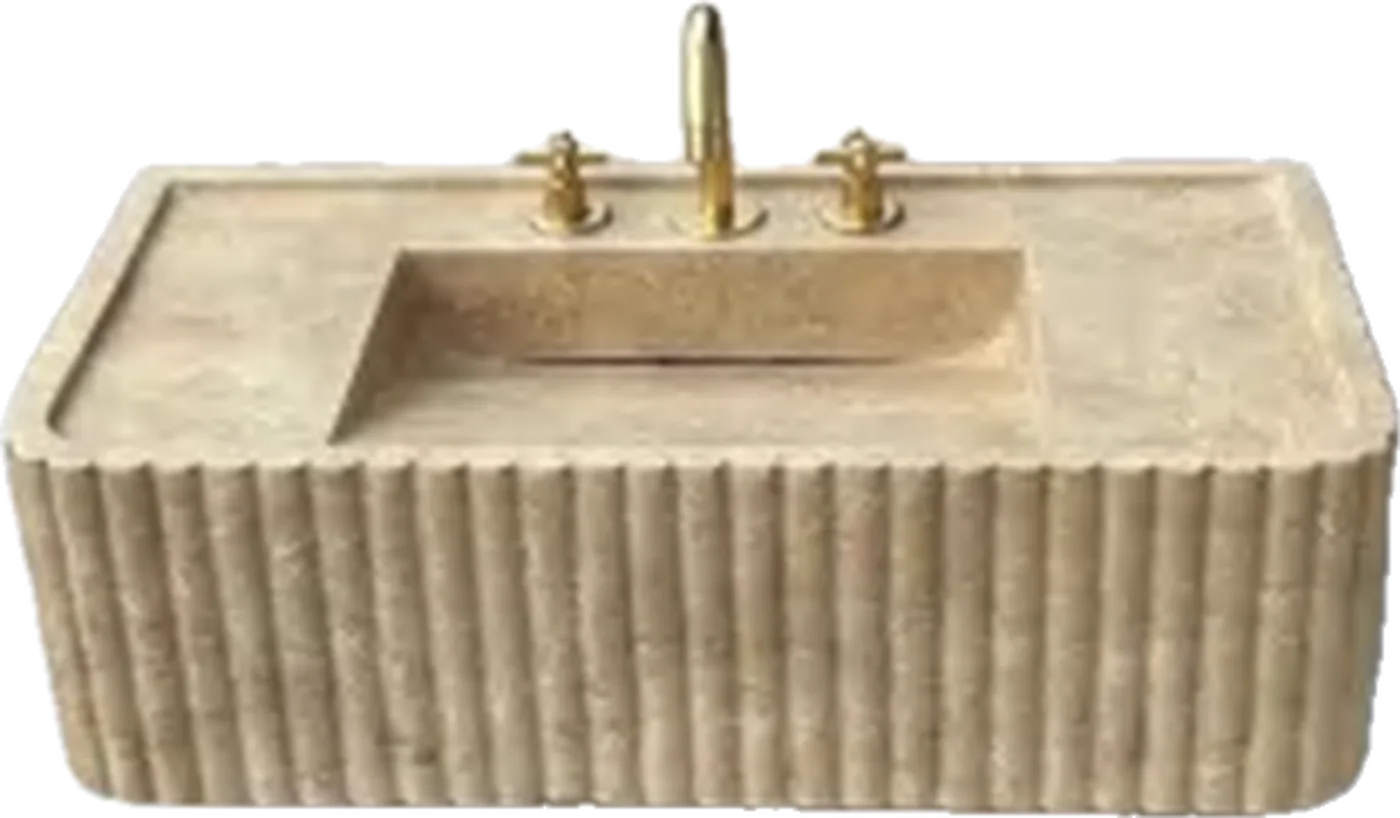
Scanalata Wall Basin
Travertine · Beige Marble
Vessel basin
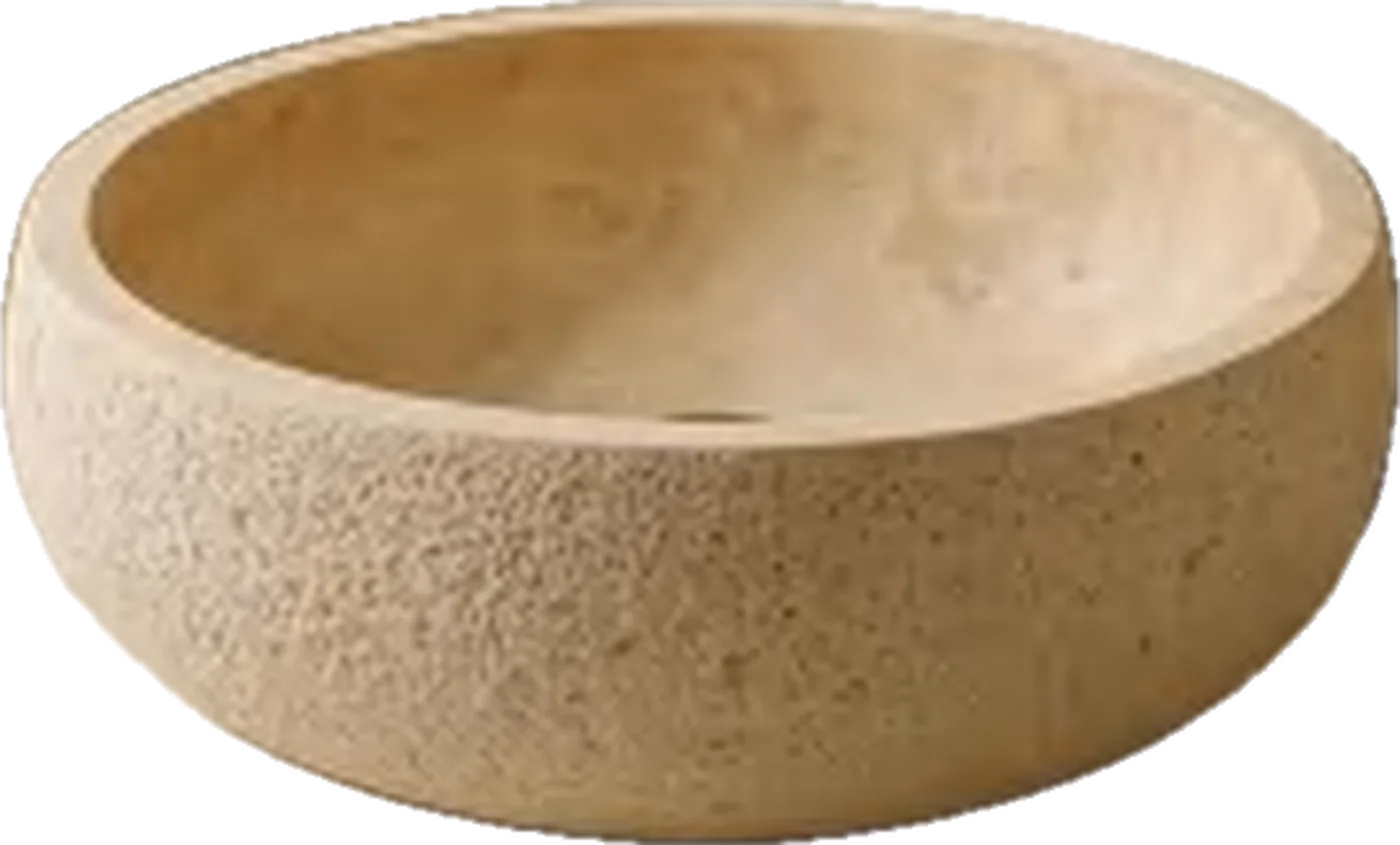
Ciotola Travertine Vessel Basin
Travertine
Vanity
Travertino Long Vanity
Beige Travertine
Vanity
Grande Double Vanity
Beige Travertine
Pedestal basin
Colonna Pedestal Basin
Beige Travertine · White Travertine
Vessel basin
Sassolino Vessel Basin
Travertine · Marble
Sources
Every piece is made to order. Tell us about the room and we reply within one business day.
Get a quoteOrder the sample book