What is Calacatta marble, and is it right for a bathtub or basin?
Last updated November 2026.

Quick answer
- Look
- Bright white ground with bold gray, gold or charcoal veins
- Stone family
- Marble: recrystallized calcite or dolomite
- ASTM C503 density
- 162 lb/ft³ minimum for calcite marble
- ASTM C503 absorption
- 0.20% by weight maximum
- Mohs hardness
- About 3 (calcite)
- Finishes
- Honed or polished
Calacatta is a trade name for white marble with a luminous ground and bold, high-contrast veining. It is chemically ordinary marble, so it carves well, absorbs little water and etches in acid. The name describes a look, and the veining is the thing to inspect on each block.
Ask about a piece in Calacatta
What is Calacatta?
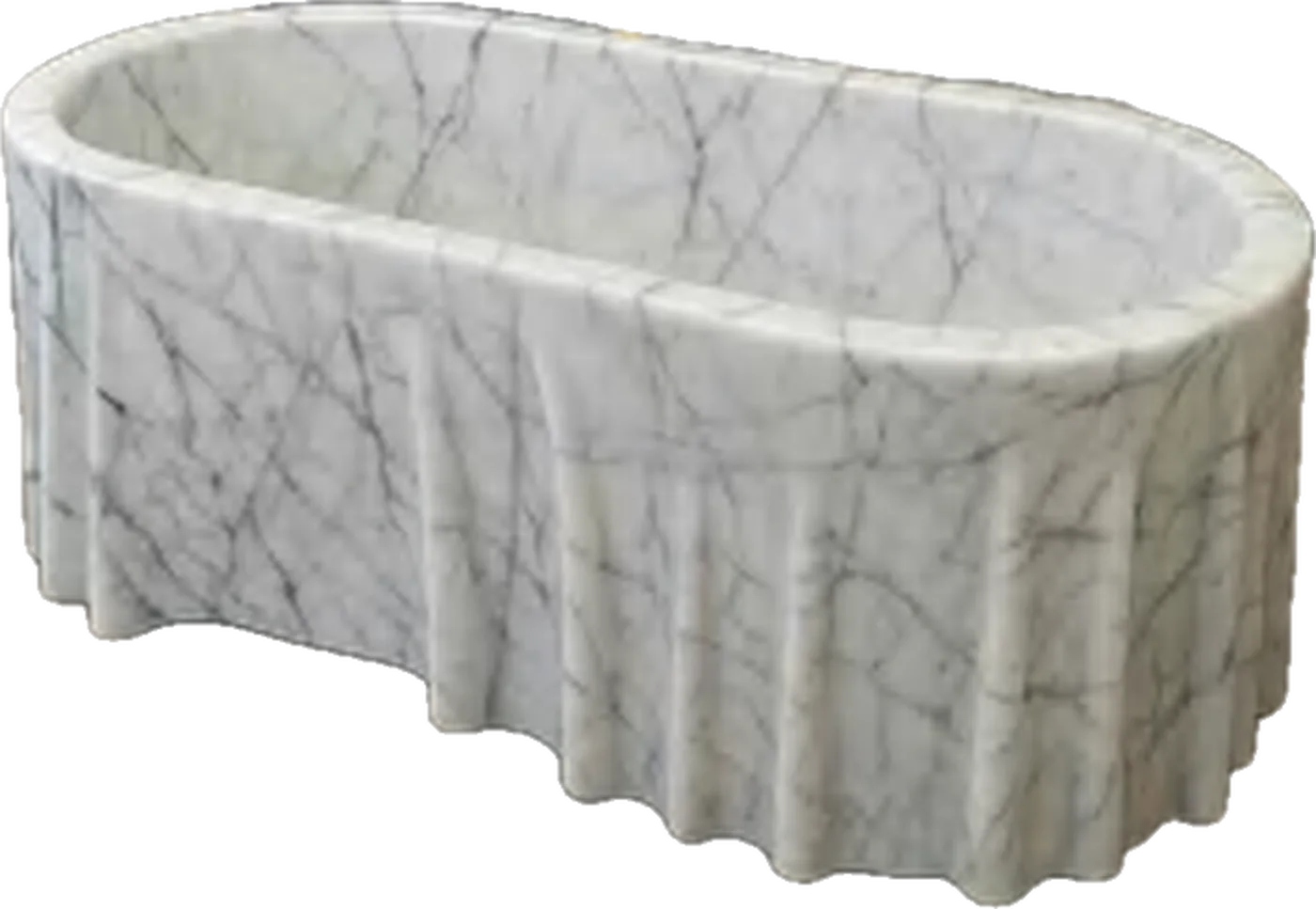
Calacatta is a name sellers use for white marble with large, high-contrast veining. A bright ground with heavy gray, gold or charcoal lines makes each piece look drawn, which is why designers pick it for a single focal tub or basin.
Its working properties are those of marble in general: dense, easily polished, low in water absorption, soft against a steel blade. The decision comes down to whether you want a quiet surface or a graphic one, and whether you accept etching as part of owning white marble.
What are the properties of Calacatta?
| Property | Calacatta |
|---|---|
| Stone family | Marble; metamorphic, built of recrystallized calcite or dolomite [7] |
| Ground color | Luminous white background [3] |
| Veining | Dramatic veining that ranges from soft gray to rich gold and charcoal [3] |
| Named varieties | Calacatta Gold, Calacatta Borghini and Calacatta Macchia Vecchia are listed as exotic Carrara-region variations [2] |
| Finishes offered | Honed and polished [3] |
| Density (ASTM C503 minimum) | 162 lb/ft³ calcite class; 175 lb/ft³ dolomite class [1] |
| Water absorption (ASTM C503 maximum) | 0.20% by weight [1] |
| Mohs hardness | Calcite is 3 [5] |
| Acid sensitivity | Calcite dissolves in dilute acid, releasing carbon dioxide [5] |
Numbers in brackets refer to the sources at the end of this page. Natural stone varies block to block.
Planning a piece in Calacatta?
Tell us about the room. We reply within one business day with options, and every quote gives the exact dimensions and weight of the piece.
What makes Calacatta different from other white marble?
Two things: the whiteness of the ground and the scale of the veins. MSI describes a luminous white background and veining from soft gray to rich gold and charcoal. Houzz describes Calacatta as whiter than Carrara with bolder, more dramatic veining, and as scarcer.
| Trait | Calacatta | Carrara (for contrast) |
|---|---|---|
| Ground | Luminous white | Gentle white to gray |
| Veining | Dramatic; gray, gold, charcoal | Subtle gray |
| Availability | Described as rarer | Described as more readily available |
Sources: MSI and Houzz comparisons of Carrara and Calacatta. Both are retailer or media pages, so treat availability as a trade view.
Does a Calacatta piece come from Italy?
Calacatta is a trade name for a type of white marble, not an origin guarantee. The name is classically tied to the Carrara region of Tuscany, and Wikipedia lists Calacatta Gold, Borghini and Macchia Vecchia among the Carrara-area variations. Sources and quarries vary.
Pietra Fonte does not claim that a piece comes from any particular quarry or country. The name tells you the look: a white marble with bold veining. If origin matters to you, ask us what we know about the block, and we will tell you what we can and cannot document.
How does Calacatta behave in a bathroom?
ASTM C503 sets a maximum absorption of 0.20% by weight and a minimum density of 162 lb/ft³ for calcite marble, so a sound block resists water well. Soap and hard-water film are an appearance issue only.
Acids are the weakness. Calcite dissolves in dilute acid, and etch marks show as dull patches, most visibly on a polished face. A honed finish masks them better, though honed marble is more absorbent and needs sealing. A wet polished tub floor is slick; ask about a honed or lightly textured base.
What should you look at before ordering a bold-veined piece?
Veins are the design, so judge them on the block, not a sample chip.
- Where heavy veins cross a rim, spout or thin wall. Ask us about any lines near edges.
- Whether the ground is the white you want, since gray cast changes the look next to white fixtures.
- Honed or polished, since the finish changes the contrast.
- Soundness: ASTM C503 sorts marble into groups A to D by how many natural voids and flaws are repaired, and the producer assigns the group.
Every piece is inspected with photos or video before it ships, so you see the pattern before delivery.
How do you care for Calacatta?
- Seal with a stone sealer and renew it when water stops beading.
- Wipe dry after use and clean with a pH-neutral stone cleaner.
- Keep citrus, vinegar, wine and bathroom sprays off it.
- Use trays for bottles and never scrub with abrasive powders.
The stone bathtub care guide gives the longer routine. For weight and floors, see the weight guide.
How does Calacatta compare with Carrara and Arabescato?
Carrara is the softer-looking choice, with a grayer ground and fine veins. It is also easier to find. Arabescato is the nearest in drama, but it covers several looks and the pattern depends on the variety.
All three are marble in the same family, so marble covers the figures and care that apply. Price differences are covered in the marble bathtub cost guide.
What does Pietra Fonte make in Calacatta?
Pietra Fonte makes made-to-order marble bathtubs, marble basins and vanities in Calacatta-look marble, carved from a single block and checked with photos or video before shipping. Every quote gives exact dimensions and weight.
Start with the sample book, or use bespoke when you need a specific vein layout.
Pieces we make in Calacatta
Sources
Every piece is made to order. Tell us about the room and we reply within one business day.
Get a quoteOrder the sample book